Buy off-the-shelf software when a standard tool already does 80 percent of what you need and your process can bend to fit it. Build custom software when the process is your advantage, when you are stitching three or four tools together by hand, or when the licence bill for a growing team has passed what a build would cost. Most UAE businesses end up with both: a ready-made core and custom pieces around it.
Key takeaways
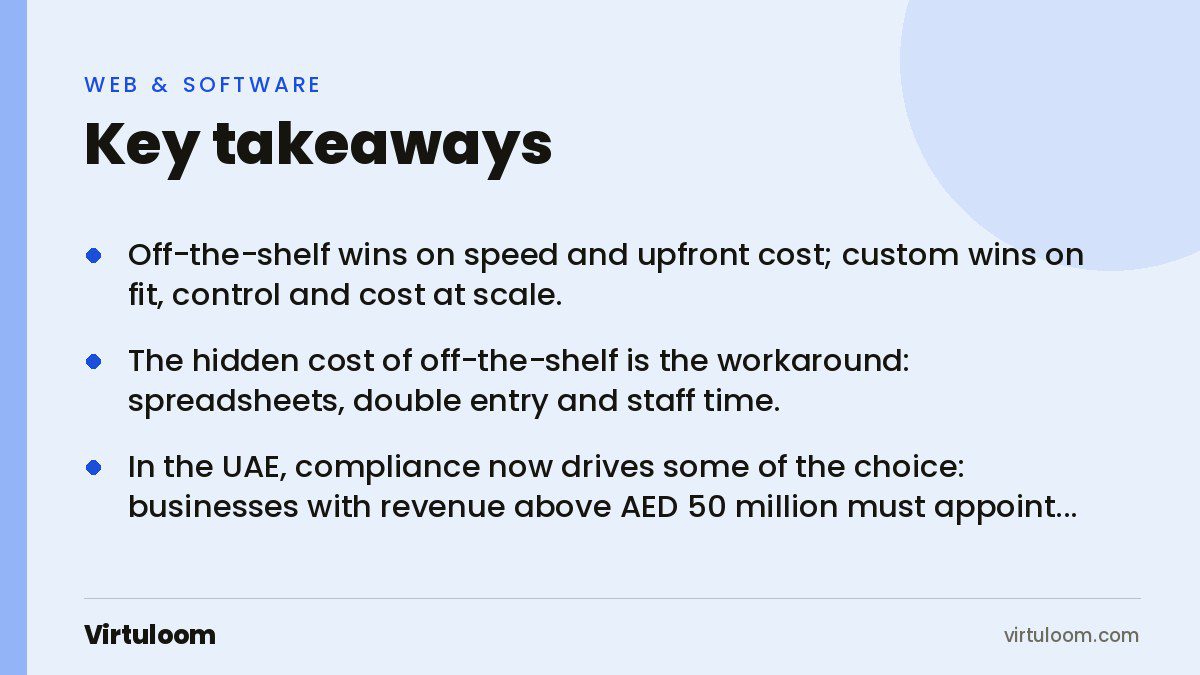
- Off-the-shelf wins on speed and upfront cost; custom wins on fit, control and cost at scale. Decide per system, not for the whole company.
- The hidden cost of off-the-shelf is the workaround: spreadsheets, double entry and staff time. The hidden cost of custom is maintenance. Price both.
- In the UAE, compliance now drives some of the choice: businesses with revenue above AED 50 million must appoint an accredited eInvoicing service provider by 30 October 2026 and fully implement eInvoicing by 1 January 2027.
- Customer data in any system falls under the UAE Personal Data Protection Law; ask where the data is stored before you sign.
- A hybrid is usually right: buy the commodity (email, accounting, payroll), build what makes you different (quoting, operations, customer experience).
What is the real difference?
Off-the-shelf software is built for thousands of businesses, so it is cheap per seat, available today and maintained by the vendor. The price is that it decides how you work. Custom software is built around how you already work, and it belongs to you, so you decide what it does next. The price is that you pay for the build and for keeping it running. Neither is better. The question is which cost you would rather carry for the next five years.
When does off-the-shelf make sense?
- The job is standard: accounting, payroll, email, basic CRM, point of sale, website hosting.
- A well-known tool covers most of what you need and the gaps are small.
- You need it this month, not this quarter.
- Your team is small and the per-seat price is manageable.
- Compliance features matter and the vendor keeps up with them, such as UAE VAT formats or, soon, eInvoicing.
When does custom make sense?
- Your process is the product: a quoting method, a dispatch flow, a membership model that no template matches.
- You run three or more tools and someone copies data between them every day.
- Licence fees have grown with headcount and now exceed what a build and its upkeep would cost over three years.
- You need Arabic and English, WhatsApp-first customer flows, or local payment and delivery integrations that the global tool treats as an afterthought.
- You want to own the data and the roadmap, and not depend on a vendor’s pricing changes.
How do you compare the cost properly?
| Cost line | Off-the-shelf | Custom |
|---|---|---|
| Upfront | Low: setup and training | High: discovery, build, testing |
| Monthly | Per-seat or per-usage licences that rise with growth | Hosting, support and a maintenance retainer |
| Workarounds | Spreadsheets, double entry, staff hours, missed data | Minimal, if the build matched the process |
| Integration | Depends on the vendor’s connectors and plan tier | Built in from the start |
| Change | Wait for the vendor, or pay for add-ons | Change when you decide, at development cost |
| Exit | Data export limits, migration project | You own the code and the database |
Put real numbers against every line for three years. Count the hours staff spend on workarounds at their loaded cost. Businesses are usually surprised twice: by how much the licences add up to, and by how much the custom maintenance costs if nobody budgeted it. Published Dubai build and maintenance ranges, which are useful for the build side of that sum, are collected in how much a website costs in Dubai.
What is different in the UAE and the Gulf?
eInvoicing. The Ministry of Finance has set the timeline: entities with annual revenue above AED 50 million must appoint an Accredited Service Provider by 30 October 2026 (extended from 31 July 2026) and fully implement the eInvoicing system by 1 January 2027. If you are in scope, the invoicing part of your stack must be able to connect to an accredited provider. That favours either a compliant off-the-shelf accounting system or a custom system built with the integration planned, not a home-grown invoicing script.
Data protection. Under the UAE Personal Data Protection Law, in force since 2 January 2022, you are responsible for how customer data is processed and secured whichever system you use. Ask vendors where data is hosted and how you can export or delete it. With custom software you choose the hosting region yourself.
Language and channels. Arabic interfaces, right-to-left layouts, WhatsApp as a primary channel, cash on delivery and local payment gateways are often weak in global tools. If these are central to your business, they are a strong argument for custom or for a local vendor.
What does the hybrid look like in practice?
A trading company keeps a standard accounting package for the books and VAT, buys a mainstream CRM for the sales team, and has a custom quoting and order-tracking portal built that pushes confirmed orders into both. A clinic keeps its licensed practice management system and adds a custom WhatsApp booking and reminder layer in Arabic and English. A real estate brokerage uses the portals’ own listing tools and builds a custom lead-routing system that answers in seconds and assigns by area. In each case the custom part is the piece customers touch or the piece that was costing hours.
A ten-minute decision check
- Write the process in ten steps. Mark which steps make you different from competitors.
- For each standard step, name the off-the-shelf tool you would use and its three-year cost at your expected headcount.
- For each differentiating step, estimate hours lost today to workarounds.
- Check compliance needs: VAT, eInvoicing scope, data location, sector regulators.
- If the differentiating steps are few and cheap to work around, buy. If they are many, or the workarounds cost more than a build and upkeep, build those parts and buy the rest.
How Virtuloom helps
We give an honest answer at the first call, including “buy it” when a ready tool fits. When custom is right, our custom software team in Dubai builds the portal, system or integration around your process, and we also set up and connect ready-made systems such as accounting, HR and payroll and restaurant management. See industry software solutions for the ready-made options, and cloud and integrations for connecting what you already have. Related reading: AI automation for Dubai businesses.
Before deciding on custom software, check what the standard tools already cover in the AI tool stack for a UAE small business.
For online stores specifically, see Shopify vs WooCommerce vs custom for the UAE and GCC, with the published plan prices and card fees.
Frequently asked questions
Is custom software always more expensive?
Upfront, yes. Over three to five years, not always. Per-seat licences grow with your team and workarounds cost staff hours, while a custom system has a fixed build cost plus maintenance. Compare both over the same period with real numbers, including the hours people spend copying data between tools.
How long does custom software take to build?
A focused first version, such as a quoting portal or a booking and reminder system, typically takes two to four months from discovery to launch. Larger systems are delivered in phases so the first useful part goes live early. Timelines stretch when requirements are undecided, so settle the process before the build starts.
Can we start with off-the-shelf and switch later?
Yes, and it is often the sensible path. Use the standard tool, record where it fails you, and after a year you will know exactly what to build. Choose tools that export your data cleanly so the later migration is a project, not a rescue.
Does eInvoicing in the UAE force a software change?
If your revenue is above AED 50 million you must appoint an Accredited Service Provider by 30 October 2026 and implement eInvoicing by 1 January 2027, so your invoicing system must connect to an accredited provider. Many accounting packages will support this; custom systems need the integration built. Smaller businesses should watch for later phases.
Who owns custom software once it is built?
You should. Make sure the contract transfers the source code, the database and the hosting accounts to your company, and that documentation is part of the delivery. Ask how support and future changes are priced, because maintenance is the cost that catches most businesses by surprise.
Sources
- Ministry of Finance announces targeted amendments to eInvoicing system decisions, UAE Ministry of Finance, May 2026
- Data protection laws, u.ae, the official portal of the UAE Government
Not sure which way to go? Contact Virtuloom for a straight answer, or message +971 52 544 4109 on WhatsApp.