
In the UAE you can be required to have audited financial statements for more than one reason at the same time. Corporate tax catches taxable persons with revenue above AED 50 million and all tax groups. Separately, your free zone may require them whatever your revenue, and DMCC gives you six months after year end to file.
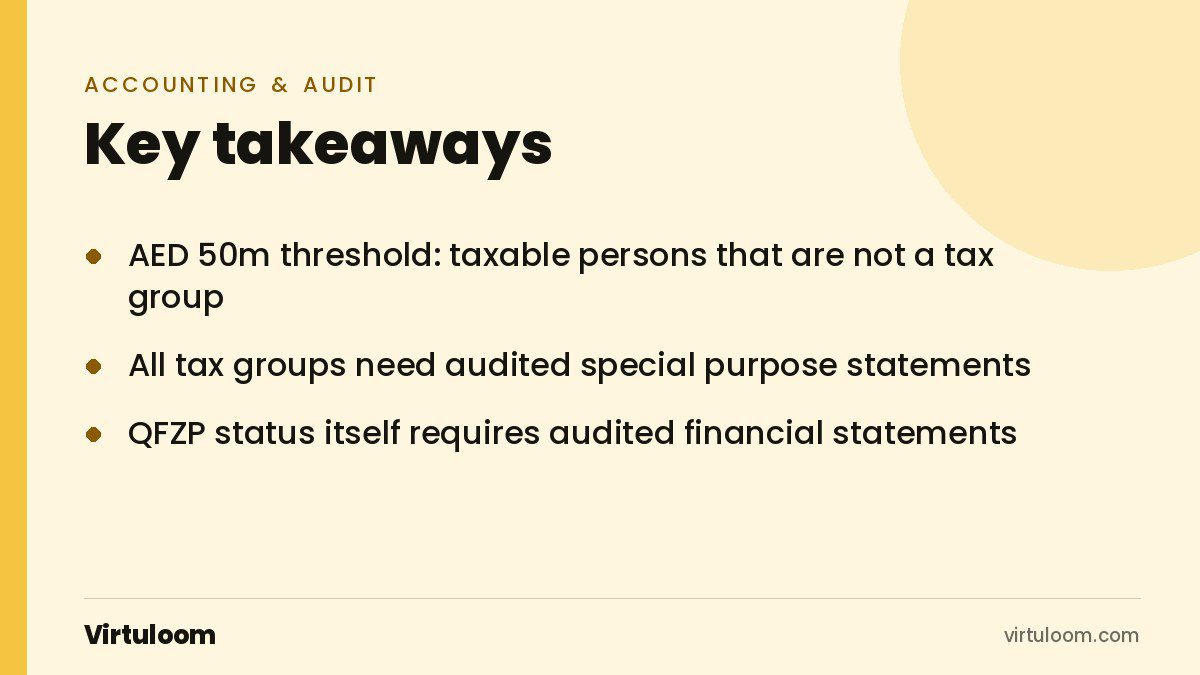
Key takeaways
- Under Ministerial Decision No. 84 of 2025, the AED 50 million revenue threshold applies to a taxable person that is not a tax group.
- All tax groups must prepare and maintain audited special purpose financial statements, whatever their revenue.
- Qualifying Free Zone Person status itself requires the entity to prepare and maintain audited financial statements.
- Free zone rules run in parallel with tax. DMCC requires submission within six months after each financial year end, from an auditor registered as a DMCC Approved Auditor.
- Corporate tax records must be kept for seven years from the end of the tax period they relate to.
Why there is no single answer
Most articles on this question answer only the corporate tax part and stop. That is why business owners in Dubai are regularly surprised: they read that they are under the AED 50 million threshold, conclude they do not need an audit, and then get a renewal notice from their free zone asking for audited statements.
The requirements sit in separate places and do not cancel each other out. Work through all four.
| Reason | Who sets it | Turns on when |
|---|---|---|
| Corporate tax | Federal Tax Authority, via Ministerial Decision | Revenue above AED 50 million, a tax group, or QFZP status |
| Your free zone or licensing authority | The free zone authority | Often every year, regardless of size |
| Banks, investors, landlords, tenders | Whoever you are dealing with | When they ask, as a condition of the facility or contract |
| Group reporting | Your parent company or its auditor | When you are consolidated into a group |
Reason 1: corporate tax
Ministerial Decision No. 84 of 2025 replaced Ministerial Decision No. 82 of 2023 and applies to tax periods commencing on or after 1 January 2025. MD 82 continues to apply to tax periods that began before that date, so which decision governs you depends on your year end, not on today’s date.
According to PwC Middle East’s alert on the decision, the AED 50 million revenue threshold “applies to a Taxable Person that is not a Tax Group”. KPMG’s guide puts the same obligation as “maintenance of audited FS is required in case of taxable persons deriving revenue exceeding AED 50 million”.
Three points that catch people out:
- Tax groups have no threshold. PwC’s alert states the decision “requires all tax groups to prepare and maintain the audited special purpose financial statements”. Special purpose financial statements are not the same document as your ordinary statutory accounts, and PwC notes that “additional guidance for the preparation of SPFS will be specified by the Authority”, so if you are in a tax group this is worth watching rather than assuming.
- Qualifying Free Zone Persons. KPMG lists preparing and maintaining audited financial statements as one of the conditions of QFZP status itself. In other words the audit is not triggered by your revenue, it is a condition of keeping the 0 percent benefit.
- Non-residents. Only revenue attributable to permanent establishments or nexuses in the State counts towards the threshold.
There is also an extra layer for some free zone distributors. PwC notes that QFZPs engaged in distributing goods or materials in or from a Designated Zone must “comply with any additional procedures prescribed by the Federal Tax Authorities”.
Reason 2: your free zone’s own rules
This is the part that runs independently of tax, and the part most owners discover late. Two examples from the authorities’ own published guidance.
DMCC. Its guidance states that “submission of Audited Financial Statements is applicable to all DMCC companies including subsidiaries and branch companies”, and that they must be submitted “within six months after the end of each financial year”. The auditor is not a free choice: companies must “ensure that their appointed auditor is registered as an Approved Auditor with DMCCA”.
JAFZA. Its guide states that “FZE and FZCO establishments must provide an updated audit report to the Authority annually”, and that “the audit report should be issued only by the auditor who has a Dubai Economic Department license”. The company must also formally appoint the auditor: “each Company must pass a resolution appointing the auditor who will prepare the audit report of the free zone company/establishment”. JAFZA also sets limits on the financial year itself, which “should not be less than 6 Months and more than 18 Months”.
Note what this means in practice. A DMCC company with AED 3 million of revenue is well under the corporate tax threshold and still files audited statements every year, from an approved auditor, inside six months.
Other free zones and mainland licensing authorities set their own conditions and they are not uniform, so check your own licence terms and your zone’s current guidance rather than assuming your neighbour’s rule applies to you.
Reason 3: someone you deal with asks for them
This one is contractual rather than regulatory, and it is often the first time a growing company gets an audit. Banks ask for audited statements as a condition of a facility or an overdraft review. Investors ask in due diligence. Government and large corporate tenders ask for them as part of prequalification. Incoming shareholders ask before they buy in.
The practical consequence is timing. These requests arrive with a two week deadline, and an audit of a year you closed loosely eight months ago takes longer than that. Companies that keep the file audit-ready answer in days. Companies that do not lose the facility or the tender.
Reason 4: group reporting
If you are consolidated into a parent, the group auditor will need your numbers in an auditable state whether or not the UAE requires an audit of your entity on its own.
There is a useful wrinkle here in DMCC’s rules. Its guidance notes that the Approved Auditor Rules “do not apply to auditors appointed to audit DMCC member companies” provided that “such companies have a group auditor”. So a subsidiary inside an audited group may not be bound by the approved auditor list in the same way. Confirm it against the current rules for your entity before relying on it.
Which standards, and how long do you keep the records?
IFRS. KPMG’s guide puts the corporate tax requirement as “preparation of Financial Statements (FS) as per IFRS”. Smaller entities commonly apply IFRS for SMEs where they are eligible, which is a question for your accountant rather than a choice you make yourself.
On retention, KPMG states that records supporting a corporate tax return “are required to be maintained for a period of 7 years from the end of the tax period to which they relate”. That is seven years from the end of the period, not from the filing date, and it covers the underlying records, not just the statements.
Deadlines to put in the calendar
| Obligation | Timing | Source |
|---|---|---|
| DMCC audited financial statements submission | Within six months after the end of each financial year | DMCC guidance |
| JAFZA audit report | Annually, with a financial year between 6 and 18 months | JAFZA guide |
| Corporate tax records retention | 7 years from the end of the tax period | KPMG, Doing Business in the UAE |
Your own corporate tax return deadline depends on your tax period, so take it from the Federal Tax Authority or your tax adviser rather than from a blog, this one included.
What the auditor will ask you for
The audit is only as quick as the file you hand over. The pack that makes it quick is the same regardless of which of the four reasons applies to you: the four statements, a trial balance that agrees to them, lead schedules for each account area, and the supporting documents behind the balances. We set out what goes in it in audit draft preparation in the UAE.
Three habits separate a clean audit from a painful one. Reconcile the bank monthly rather than in March. Keep related party balances agreed in writing at both ends. And file contracts, invoices and lease agreements where someone other than you can find them.
Common mistakes
- Assuming the tax threshold is the only test. Your free zone rule may bind you at a fraction of AED 50 million.
- Appointing any auditor. DMCC requires a registered Approved Auditor and JAFZA requires a Dubai Economic Department licence. An audit from the wrong firm can be rejected.
- Not passing the appointment resolution. JAFZA requires it in writing, and it is often missing from otherwise complete files.
- Treating a tax group like a single company. Audited special purpose financial statements are a separate requirement with guidance still developing.
- Starting at the deadline. Six months sounds generous until the auditor asks for something from month two that nobody kept.
How Virtuloom helps
Virtuloom is a technology company, not an audit firm. What we build is the software side: systems that keep the ledger and the supporting documents in an auditable state through the year, so the pack your accountant hands to the auditor is complete the first time. See our custom software and AI automation pages, or how firms are using Claude Skills in accounting and audit work.
Frequently asked questions
Who needs audited financial statements in the UAE in 2026?
For corporate tax, taxable persons with revenue above AED 50 million that are not a tax group, all tax groups, and Qualifying Free Zone Persons as a condition of that status. Separately, many free zones require them annually at any revenue level, and banks, investors and tenders ask for them contractually.
What is the AED 50 million threshold exactly?
It is a revenue threshold under Ministerial Decision No. 84 of 2025, and PwC’s alert states it applies to a taxable person that is not a tax group. For non-resident persons, only revenue from permanent establishments or nexuses in the State counts towards it.
Do free zone companies need an audit even below the threshold?
Often yes, under the free zone’s own rules rather than tax law. DMCC requires audited financial statements from all DMCC companies, including subsidiaries and branches, within six months of the financial year end. JAFZA requires FZE and FZCO entities to provide an audit report annually.
Can any auditor sign our UAE audit report?
No. DMCC requires the appointed auditor to be registered as an Approved Auditor with DMCCA. JAFZA requires an auditor holding a Dubai Economic Department licence, and requires the company to pass a resolution appointing them. Check your own zone’s list before engaging anyone.
How long do we have to keep the records?
Seven years from the end of the tax period the records relate to, according to KPMG’s guide to corporate tax compliance. That applies to the underlying records supporting the return, not only to the financial statements themselves.
What are special purpose financial statements?
They are statements prepared for a specific purpose rather than general use. Ministerial Decision No. 84 of 2025 requires all tax groups to prepare and maintain audited special purpose financial statements, and PwC’s alert notes that further guidance on preparing them was still to be specified by the Authority. Ask your tax adviser what form yours should take.
Sources
- UAE Corporate Tax: Ministerial Decision No. 84 of 2025 on Audited Financial Statements, PwC Middle East
- Doing Business in the UAE, KPMG
- Guidelines: Submission of Audited Financial Statements, DMCC
- Audit Report Submission (FZE & FZCO), Jebel Ali Free Zone
This article explains what published official and Big Four sources say as of October 2026 and is not accounting, audit, tax or legal advice. Virtuloom is not an audit firm. Rules change and free zone conditions differ, so confirm your own position with your adviser, your licensing authority and the Federal Tax Authority. Any draft prepared from your records is for review by a qualified accountant and, where an audit is required, for audit by a licensed auditor.
If you want the systems behind your ledger tightened so the audit file is ready before it is asked for, talk to us.