The Unseen Revolution: Why Traditional Selling is Collapsing
Let’s be brutally honest: the era of relying solely on physical products and static imagery to drive sales is rapidly fading. In 2026, if your brand is still pushing pixels and hoping for the best, you’re not just falling behind you’re actively becoming irrelevant. The market has evolved, consumer expectations have skyrocketed, and the digital landscape demands more than just a pretty picture. It demands immersion, interaction, and instant gratification. The question isn’t if your traditional selling methods will collapse, but when.
Save this idea: The future of commerce isn’t about what you have, but what you can simulate.
Beyond Pixels: The Evolution of 3D Rendering
Remember when 3D rendering was a niche tool for architects and animators? Those days are long gone. Today, 3D rendering has matured into a sophisticated, hyper-realistic, and incredibly versatile technology that’s reshaping entire industries. It’s no longer just about creating a visual; it’s about crafting an experience, a tangible sense of presence that transcends the physical.
Industry Disruption: Selling the Unseen
Real Estate: Virtual Property Tours & Remote Selling
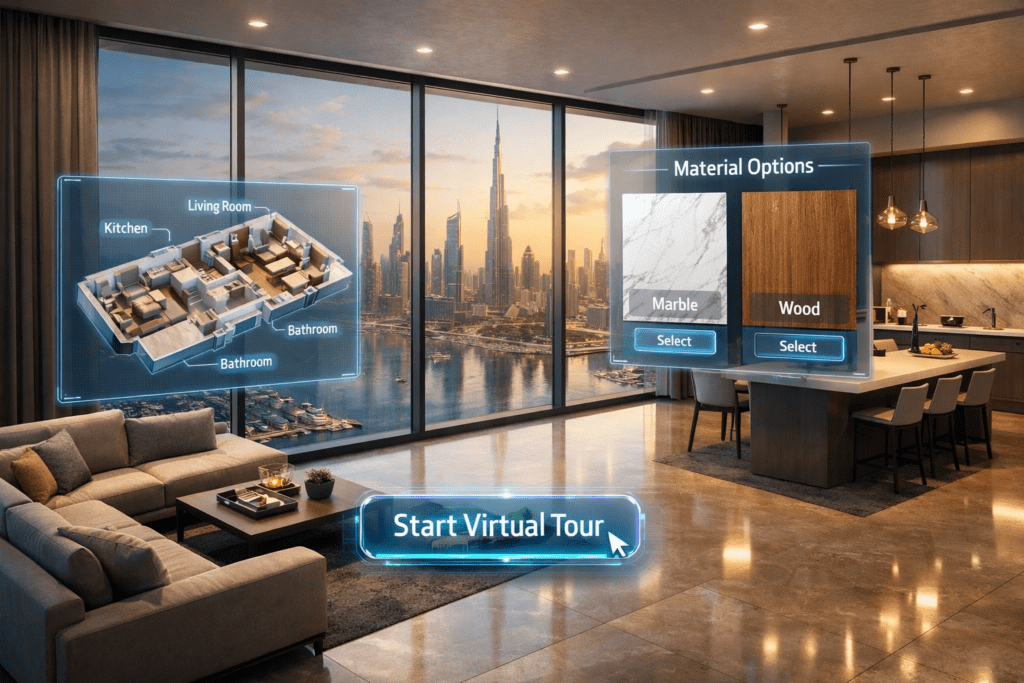
The real estate market, particularly in global hubs like Dubai, is undergoing a profound transformation. Imagine selling a multi-million dollar penthouse to an international investor who has never set foot in the country. Impossible a decade ago, but now, it’s the standard. 360 virtual tours real estate solutions, powered by advanced 3D rendering trends 2026, allow potential buyers to explore every corner of a property, customize finishes, and even visualize furniture placement all from their living room. This isn’t just a convenience; it’s a strategic advantage that expands your market reach exponentially. In fact, virtual tours have been shown to drive 40% more leads and 72% more net leases . The global virtual tour market, valued at around $11 billion in 2024, is expected to skyrocket to $74 billion by 2030 .
Fashion: Virtual Try-Ons & Digital Showrooms
Fashion is no longer confined to the runway or the changing room. Brands are leveraging fashion 3D visualization to create digital twins of their collections, enabling virtual try-ons that allow customers to see how garments fit and move on their own avatars. Digital showrooms offer an immersive experience, presenting entire collections in a dynamic, interactive environment, eliminating the need for costly physical samples and reducing waste. This is sustainable, scalable, and undeniably chic.

Interior Design: Immersive 360 Walkthroughs
For interior designers, the ability to present concepts with absolute clarity is paramount. Immersive digital experiences through 360 walkthroughs allow clients to step into their future spaces, experiment with different layouts, materials, and lighting, and make informed decisions before a single piece of furniture is ordered. This drastically reduces revisions, accelerates project timelines, and elevates client satisfaction to unprecedented levels.
The Business Impact: Beyond the Hype
The shift to 3D rendering isn’t just about cool tech; it’s about tangible business outcomes:
•Higher Conversion Rates: Immersive experiences build confidence and reduce buyer’s remorse, leading to more decisive purchases.
•Reduced Operational Costs: Minimize expenses associated with physical showrooms, sample production, and travel.
•Global Sales Without Physical Presence: Break down geographical barriers and tap into new markets with unparalleled ease.
Real-World Scenario: Dubai’s Digital Skyline
Consider the burgeoning luxury real estate market in Dubai. Developers are no longer waiting for construction to complete to start selling. They’re using hyper-realistic 3D renderings and virtual reality experiences to sell off-plan properties, allowing buyers from London to New York to walk through their future homes years before they’re built. This strategy isn’t just innovative; it’s a competitive imperative, driving pre-sales and securing investments at an unprecedented pace. For instance, a leading developer in Dubai recently sold out an entire off-plan luxury tower to international investors, primarily through immersive 3D walkthroughs and interactive digital models, significantly reducing their marketing spend on physical show units. This trend is also gaining significant traction in Australia 3D rendering markets and across Europe 3D visualization hubs, where remote buyers are increasingly common. The 3D rendering market in Australia alone is projected to reach US$ 394.2 million by 2033 .
The Virtuloom 3D Rendering Process for Real Estate
At Virtuloom, our process ensures unparalleled realism and efficiency:
1.Conceptualization & Data Collection: We begin by gathering architectural plans, material specifications, and design inspirations. For global projects, especially in the GSC region or Europe, we ensure compliance with local architectural styles and regulations.
2.3D Modeling: Our expert modelers create precise 3D models of the property, including intricate details of interiors, exteriors, and landscaping.
3.Texturing & Lighting: We apply realistic textures and sophisticated lighting techniques to mimic natural light conditions and material properties, creating photorealistic scenes.
4.Rendering & Post-Production: High-resolution images, 360 virtual tours, and animated walkthroughs are rendered. Post-production enhances visual appeal, adding elements like landscaping, furniture, and human activity to bring the scene to life.
5.Interactive Integration: For immersive digital experiences, we integrate these assets into interactive platforms, allowing clients to explore, customize, and even make virtual modifications to the property.
This meticulous process ensures that whether you’re targeting buyers in Sydney, London, or Dubai, your property is presented with maximum impact and accuracy.
The Merge: AI + 3D + Immersive Commerce
The true power emerges when AI in 3D rendering converges with immersive technologies. AI-powered rendering engines can generate photorealistic scenes in real-time, adapt to user preferences, and even predict design trends. This fusion creates a dynamic, responsive, and infinitely scalable commerce ecosystem where every interaction is personalized and every product is presented in its most compelling form.
Image Suggestion 4: A futuristic dashboard showing AI algorithms at work, generating 3D models and immersive environments in real-time, with data streams and holographic interfaces.
The Fatal Flaw: Ignoring 3D Visualization
Here’s a bold opinion: any business in real estate, fashion, or interior design that isn’t actively investing in 3D visualization by 2026 is making a critical strategic error. You’re not just missing an opportunity; you’re actively ceding market share to competitors who understand the power of the unseen. The cost of inaction far outweighs the investment in innovation.
Ask yourself: Are you leading the charge into the future of commerce, or are you clinging to a past that no longer serves your customers?
2D Marketing vs. 3D Immersive Selling: A Framework for the Future
| Feature | 2D Marketing (Outdated) | 3D Immersive Selling (Future-Proof) |
| Engagement | Passive viewing | Active interaction, emotional connection |
| Product Display | Static images, limited angles | Dynamic, customizable, 360-degree views |
| Customer Journey | Linear, often disjointed | Seamless, guided, personalized |
| Cost Efficiency | High physical overhead (samples) | Reduced physical costs, scalable digital |
| Global Reach | Limited by physical presence | Borderless, instant access to any market |
| Conversion | Relies on imagination | Drives confident, informed decisions |
Your Next Move: Crafting a Human-Written Strategy for a 3D World
The future of selling without physical products isn’t a distant dream; it’s here. It’s about leveraging cutting edge 3D rendering trends 2026, embracing AI in 3D rendering, and creating truly immersive digital experiences. But remember, technology is merely a tool. The true magic lies in the human strategy behind itthe creativity, the vision, and the understanding of what truly moves your audience.
Save this idea: The most advanced tech still needs a human touch to truly resonate.
Are you ready to transform your sales strategy and captivate a global audience without the constraints of the physical world? Are you prepared to lead, rather than follow, in this exhilarating new era of commerce?
Virtuloom stands at the forefront of this revolution, blending AI, custom software, 3D rendering, and digital experience solutions to empower brands like yours. We don’t just build technology; we craft the future of how you sell.
Ready to redefine your market presence?
👉 Discover Our AI Solutions to start your immersive journey today. For bespoke solutions tailored to your global market needs, including 3D rendering for real estate in Dubai, fashion 3D visualization in Europe, or immersive digital experiences in Australia, contact us for a consultation. We are your partner in digital transformation.
References
[1] Why virtual tours convert: New case study data from LCP… – blog.reachbyrentcafe.com
[2] Why Unit-Level Virtual Tours are the Future of Real Estate – theviewpro.com
[3] Australia 3d Rendering Market Size & Outlook, 2026-2033 – grandviewresearch.com
Further Reading:
•How AI and Automation Are Transforming Social Media Content
•Building Custom Software for Immersive Experiences