llms.txt is a plain Markdown file at the root of your website that lists your most important pages with a one-line summary of each, written for AI systems rather than people. It is a proposal, not a standard. Google’s John Mueller said in June 2025 that “no AI system currently uses llms.txt”, and nothing official has changed that since. It costs ten minutes to add, does no harm, and should sit far below crawlable pages, direct answers and consistent business facts on your list.
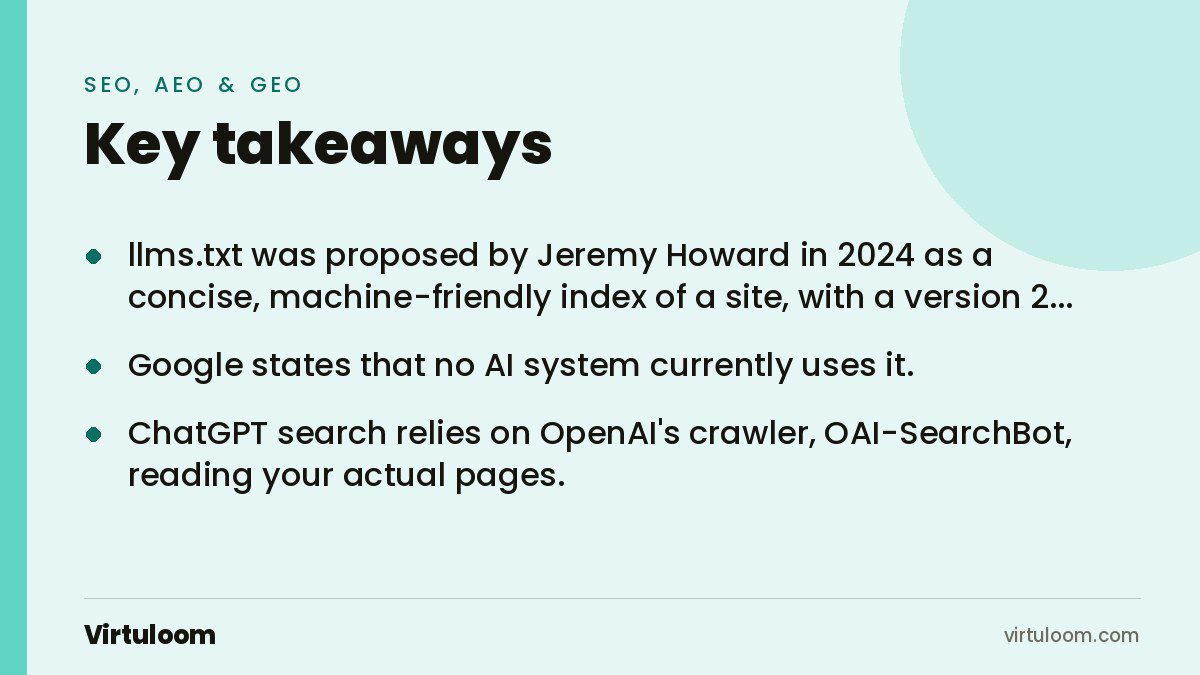
Key takeaways
- llms.txt was proposed by Jeremy Howard in 2024 as a concise, machine-friendly index of a site, with a version 2 of the proposal in August 2026.
- Google states that no AI system currently uses it. Google’s own guidance says there are no special requirements to appear in AI Overviews or AI Mode beyond normal SEO.
- ChatGPT search relies on OpenAI’s crawler, OAI-SearchBot, reading your actual pages. Blocking that crawler removes you from ChatGPT search; adding llms.txt does not add you.
- Adding one is harmless and cheap. Treat it as a tidy index for machines, keep it accurate, and do not expect rankings from it.
- What does move AI visibility: pages the crawlers can read, a direct answer in the first paragraph, consistent facts across the web, and mentions on other sites.
What is llms.txt exactly?
The proposal at llmstxt.org describes a Markdown file served at /llms.txt. It starts with an H1 containing the site or project name, then a blockquote with a short summary, then optional sections and H2-headed lists of links, each with a short description. The idea is that an AI agent visiting your site gets “concise, expert-level information gathered in a single, accessible location” instead of burning tokens on navigation, menus and ads. The file can also live at a subpath, so /docs/llms.txt covers the documentation section only.
A simple example for a Dubai agency:
# Virtuloom
> Digital and technology company in Dubai: websites, software, AI agents, marketing, photography.

## Services
- [AI agents](https://www.virtuloom.com/ai-agents-dubai/): WhatsApp and web chat agents for sales and support in Arabic and English.
- [Web development](https://www.virtuloom.com/web-development/): bilingual websites and online stores built to rank.

## Blog
- [Local SEO in Dubai](https://www.virtuloom.com/local-seo-dubai-checklist/): Google Business Profile checklist for UAE businesses.
Do AI engines read it?
The honest answer is: not in any documented way. On 17 June 2025 Google’s John Mueller wrote that “no AI system currently uses llms.txt”, adding that consumer AI systems fetch normal web pages for training and grounding but none retrieve this file. Google’s documentation for site owners says there are “no additional requirements to appear in AI Overviews or AI Mode, nor other special optimizations necessary”. OpenAI’s crawler documentation describes OAI-SearchBot reading pages to power ChatGPT search and says nothing about llms.txt. Anthropic’s and Perplexity’s public documentation do not reference it either.
Some developer-tool companies publish llms.txt for their documentation, where coding assistants can be pointed at it directly. That is a different use: a developer pastes the URL into a tool. It is not search engines discovering and using the file on their own.
Should you add one anyway?
Yes, if it takes you ten minutes and you keep it accurate. No, if it replaces real work. Reasons for: it costs nothing, it is a clean inventory of your key pages, and if an agent is pointed at your site it saves tokens. Reasons against: it can go stale and contradict your pages, and some teams treat it as done instead of fixing the things that matter. One practical note: because the file is plain text at a public URL, search engines can index it as a page. Keep it short and factual so it does not clutter your results.
What actually moves AI visibility?
| Lever | Why it works | Effort |
|---|---|---|
| Crawlable pages | Engines search and read your HTML. Blocked bots, JavaScript-only content and slow pages are invisible. | Low: check robots.txt and render |
| Direct answers | Answer engines quote passages. The first 40 to 60 words under each heading should answer the heading. | Medium: rewrite key pages |
| Consistent facts | Models cross-check name, address, services, prices across your site, Google profile, LinkedIn and directories. | Low: align everything |
| Structured data | Organization, Service, FAQPage and Article schema make meaning explicit. | Low to medium |
| Mentions elsewhere | Engines prefer businesses described on several sites: directories, reviews, press, client sites. | Ongoing |
| llms.txt | Harmless index; no documented engine use. | Ten minutes |
How to create llms.txt in ten minutes
- List your 10 to 30 most important URLs: services, key guides, contact.
- Write one factual line for each: what it is and who it is for.
- Put them in the Markdown format above, H1, blockquote, H2 sections, links with descriptions.
- Save as llms.txt in the root of your site, so it opens at yourdomain.com/llms.txt.
- Add a reminder to update it when you publish or remove pages. A stale file is worse than none.
On WordPress, Rank Math and several other SEO plugins can generate the file for you from your pages and posts.
A note for Gulf businesses
If you serve Arabic and English, list both versions of each key page with a short description in each language. Mention the emirates or countries you serve in the summary line, because “web developer in Dubai” and “web developer in Riyadh” are different answers. And put your WhatsApp number in the summary: it is the contact method an AI assistant will relay to a Gulf customer.
How Virtuloom helps
Our SEO, AEO and GEO service fixes the things that do move AI visibility: crawler access, direct-answer content, schema and consistent business facts, in Arabic and English. We add llms.txt as part of the setup and keep it current. For the bigger picture, read how to make your business visible in ChatGPT and Gemini and our GEO, AEO and SEO guide for the UAE.
Frequently asked questions
Does llms.txt improve Google rankings?
No. Google does not use it for ranking or for AI Overviews, and its guidance says normal SEO is what gets pages into AI features. It will not hurt either. Spend the time on crawlable pages, direct answers and consistent business information, which Google’s systems and answer engines actually read.
Does ChatGPT read llms.txt?
OpenAI’s documentation describes ChatGPT search using its OAI-SearchBot crawler to read web pages and does not mention llms.txt. What matters for ChatGPT visibility is that OAI-SearchBot is allowed in your robots.txt and that your pages answer questions clearly.
What is the difference between llms.txt and robots.txt?
robots.txt is a standard every major crawler obeys; it tells bots what they may and may not fetch. llms.txt is a proposal that describes your site for AI tools in Markdown. One controls access and is widely used; the other is an optional index with no documented engine support.
Is there an llms-full.txt?
Some sites publish a longer companion file that contains the full text of their documentation in one place, so a tool can load it in a single request. It is useful for developer documentation that people deliberately feed to coding assistants. For a business website it adds little.
Can llms.txt hurt my site?
Only indirectly: if it lists wrong prices, old addresses or pages that no longer exist, it contradicts your site. It can also be indexed as a plain-text page, so keep it short and factual. Update it when you publish or remove pages, or let your SEO plugin generate it.
Sources
- The /llms.txt file, llmstxt.org
- Google says no AI system currently uses llms.txt, Search Engine Roundtable, June 2025
- AI features and your website, Google Search Central
- Overview of OpenAI crawlers, OpenAI
Want to know what AI engines can actually read on your site? Ask Virtuloom for a check or message +971 52 544 4109 on WhatsApp.