A chatbot answers questions from a script or a knowledge base. RPA is a software robot that repeats a fixed, rule-based task across your systems. An AI agent uses a language model to decide what to do next, calls tools, and completes a goal with several steps. Pick the chatbot for FAQs, RPA for high-volume repetitive back-office work with structured data, and an agent for jobs that need judgement across channels and systems, with a person checking the edges.
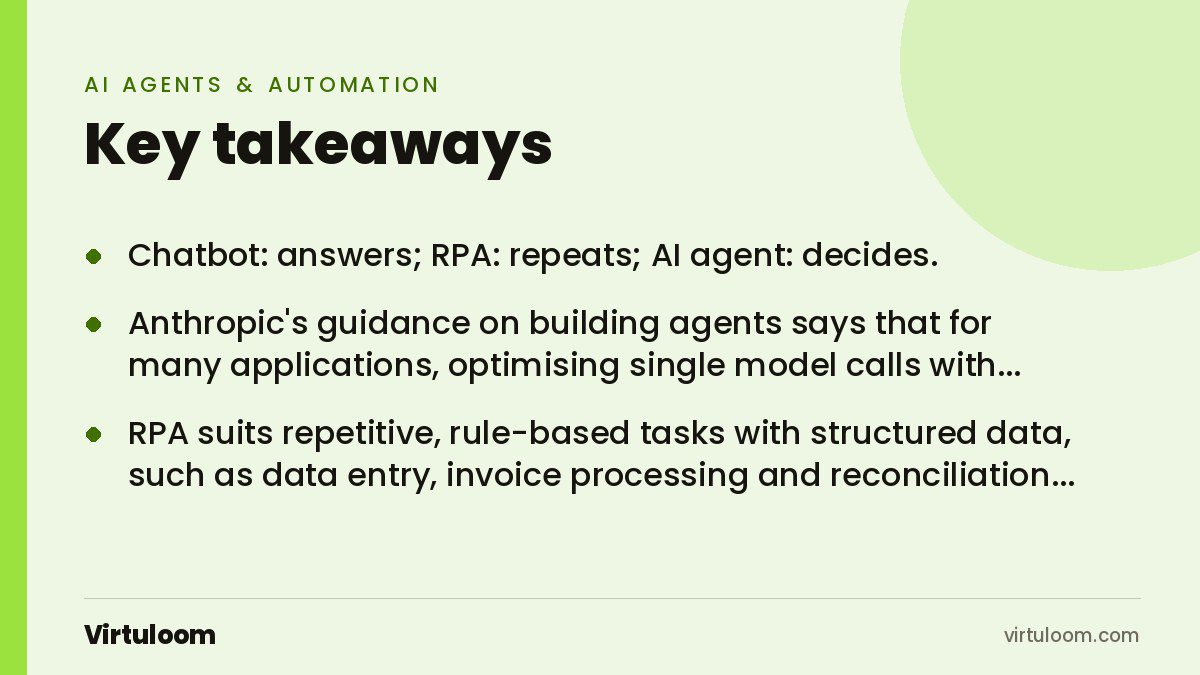
Key takeaways
- Chatbot: answers; RPA: repeats; AI agent: decides. Most businesses need two of the three, not one.
- Anthropic’s guidance on building agents says that for many applications, optimising single model calls with retrieval and examples “is usually enough”, and that agents “often trade latency and cost for better task performance”. Start simple.
- RPA suits repetitive, rule-based tasks with structured data, such as data entry, invoice processing and reconciliation, in UiPath’s own description.
- Agents need guardrails: sandboxed testing, checkpoints where a human can step in, and clear limits on what they may do.
- In the Gulf the deciding factors are WhatsApp, Arabic and English, and the legacy systems you already run.
What is a chatbot?
A chatbot is software that replies to messages. The old kind followed a decision tree: press 1 for hours, press 2 for prices. The current kind uses a language model to understand a free-text question and answer from a knowledge base you give it. It can collect details, share links and hand over to a person. What it does not do is act: it will not check your inventory system, book the slot in your calendar or create the invoice unless someone has wired those actions in, at which point it has become an agent.
Good fit: hours, prices, location, how-to questions, lead capture, first-line support in Arabic and English, after-hours replies.
What is RPA?
Robotic process automation means software robots that, in UiPath’s words, “handle repetitive, rule-based tasks like entering data, moving files, or processing transactions”. A robot logs into the accounting system, copies figures from an email attachment into the right fields, reconciles a statement, and moves on, the same way every time. It works well with structured data and defined rules, and it is the usual way to automate across old systems that have no API, because the robot drives the screen like a person would.
Good fit: invoice entry, bank reconciliation, payroll file preparation, moving data between a legacy ERP and a newer tool, monthly reports, anything a clerk does the same way 500 times a month.
What is an AI agent?
Anthropic distinguishes workflows, where models and tools are “orchestrated through predefined code paths”, from agents, where models “dynamically direct their own processes and tool usage”. In plain terms, an agent is given a goal, a set of tools and some rules, and it works out the steps: read the WhatsApp message, look up the order, decide the customer qualifies for a replacement under your policy, create the return, confirm, and escalate if the amount is above a threshold.
That flexibility is the point and the risk. The same guidance recommends agents only “when flexibility and model-driven decision-making are needed at scale”, with extensive testing in sandboxed environments and designs that “pause for human feedback at checkpoints or when encountering blockers”.
Good fit: sales qualification and booking across WhatsApp and web chat, support that needs to look things up and take actions, research and drafting, multi-step back-office work where the inputs vary.
Side by side
| Chatbot | RPA | AI agent | |
|---|---|---|---|
| Core job | Answer questions, collect details | Repeat a fixed process across systems | Reach a goal with several steps and decisions |
| Input | Customer messages | Structured data, files, screens | Messages, documents, system data, unstructured input |
| Handles variation | Some, within the knowledge base | Poorly; exceptions break the robot | Well, within its rules |
| Takes actions in systems | Rarely | Yes, exactly as scripted | Yes, choosing which tool to use |
| Cost to run | Low | Low per task once built, licence per robot | Higher per task; model calls and tool use |
| Risk if wrong | Wrong answer | Wrong data entered at scale | Wrong action; needs limits and checkpoints |
| Typical time to pilot | 1 to 2 weeks | 2 to 6 weeks per process | 2 to 4 weeks for one channel |
Which one does your business need?
- Customers ask the same twenty questions on WhatsApp and Instagram. Chatbot, bilingual, with hand-over to a person.
- Your accounts team retypes supplier invoices into the ERP. RPA, or an agent that reads the PDF and an RPA robot that enters it, if the ERP has no API.
- Leads arrive at midnight and go cold by morning. AI agent: qualify, answer, book into the calendar, hand over.
- Bookings, cancellations and reschedules with a dozen exceptions. AI agent with your policy as rules, and a person for refunds.
- A monthly report assembled from four systems. RPA if the systems are stable; an agent if the sources and formats change.
- Replying to tenders or drafting proposals from past work. Agent with retrieval, a human signs off.
Most companies end up with a chatbot at the front, an agent for the jobs that need judgement, and RPA or integrations underneath to do the mechanical work reliably. UiPath describes the split the same way: agents analyse and decide, robots execute across systems.
What is different in the UAE and the Gulf?
- WhatsApp first. Whatever you build must live where customers already are. A web-only chatbot misses most conversations here.
- Two languages, mixed. Customers switch between Arabic and English mid-message and write dialect. Test with real inbox messages before launch, not textbook Arabic.
- Legacy systems. Many trading, construction and real estate firms run older accounting and ERP tools without APIs. That is where RPA still earns its place.
- Compliance deadlines. UAE eInvoicing is arriving for larger businesses, and the Personal Data Protection Law applies to any system holding customer data. Automations that touch invoices or personal data need those rules built in.
- Working hours. Customers shop late and on weekends. The first reply at 11 pm is the whole business case for a chatbot or an agent.
How to start without overbuilding
- List the ten tasks that eat the most staff hours. Mark each as answer, repeat or decide.
- Start with one: the chatbot if customer questions dominate, RPA if a single back-office process dominates, an agent if lost leads dominate.
- Define what the system may not do: no discounts, no refunds above a limit, no changes to accounting entries without review.
- Pilot for two to four weeks with a person reviewing the logs daily.
- Measure one number per task: first-reply time, hours saved, meetings booked, error rate. Expand only when it moves.
How Virtuloom helps
We build all three and tell you which you need. AI agents for sales and support on WhatsApp and web chat, automation for back-office work including integrations and robots where systems have no API, and bilingual assistants for customer questions. If you are deciding between a ready tool and a custom build, read custom software vs off-the-shelf, and for the sales side, AI sales agents in the UAE.
If you decide an automation tool is enough for now, see n8n vs Make vs Zapier for UAE businesses for the billing differences before you pick one.
Frequently asked questions
Is an AI agent just a smarter chatbot?
No. A chatbot answers; an agent acts. An agent is given a goal and tools, such as your calendar, CRM or order system, and decides the steps to reach the goal. That makes it more capable and more in need of limits, testing and checkpoints where a person can step in, as Anthropic’s guidance recommends.
Is RPA outdated now that AI agents exist?
No. RPA remains the reliable way to execute fixed, rule-based tasks across systems, especially older ones without APIs. UiPath describes agents and robots as complementary: agents analyse and decide, robots carry the action out consistently with an audit trail. Many Gulf businesses need both.
Which is cheapest to start with?
A chatbot, usually. One channel, a knowledge base built from your real customer questions, and a hand-over rule can be live in one to two weeks. RPA costs more per process to build and licence. Agents cost more per task to run because of model and tool calls, so use them where judgement actually matters.
Can these work in Arabic?
Chatbots and agents built on current language models handle Arabic, including Gulf dialect and mixed Arabic-English messages, if they are tested on real conversations before launch. RPA is language-neutral because it works with structured data and screens. Always run your last 50 inbox messages through a chatbot or agent before going live.
How do we keep an AI agent safe?
Give it a narrow goal, a short list of tools, and written rules about what it may not do. Test in a sandbox with real cases, add checkpoints where it pauses for a person on refunds, large amounts or anything unusual, review logs daily during the pilot, and keep a human responsible for the outcome.
Do we need a developer or can we use a no-code tool?
Simple chatbots and basic automations can be built with no-code tools. Once you connect systems, handle exceptions, need Arabic quality or want an agent that takes actions in your CRM or store, you need someone who can integrate, test and maintain it. Start small, but plan for the integration work.
Sources
- Building effective agents, Anthropic
- What is robotic process automation (RPA)?, UiPath
- Data protection laws, u.ae
Not sure which of the three you need? Contact Virtuloom for a straight answer, or message +971 52 544 4109 on WhatsApp.