Claude Code is Anthropic’s coding agent. It reads a codebase, edits files, runs commands and works with tools such as Git, from the terminal, an IDE, a desktop app or the browser. It is included in every paid Claude plan, so a company on the Team plan already has it at no extra seat cost.
Key takeaways
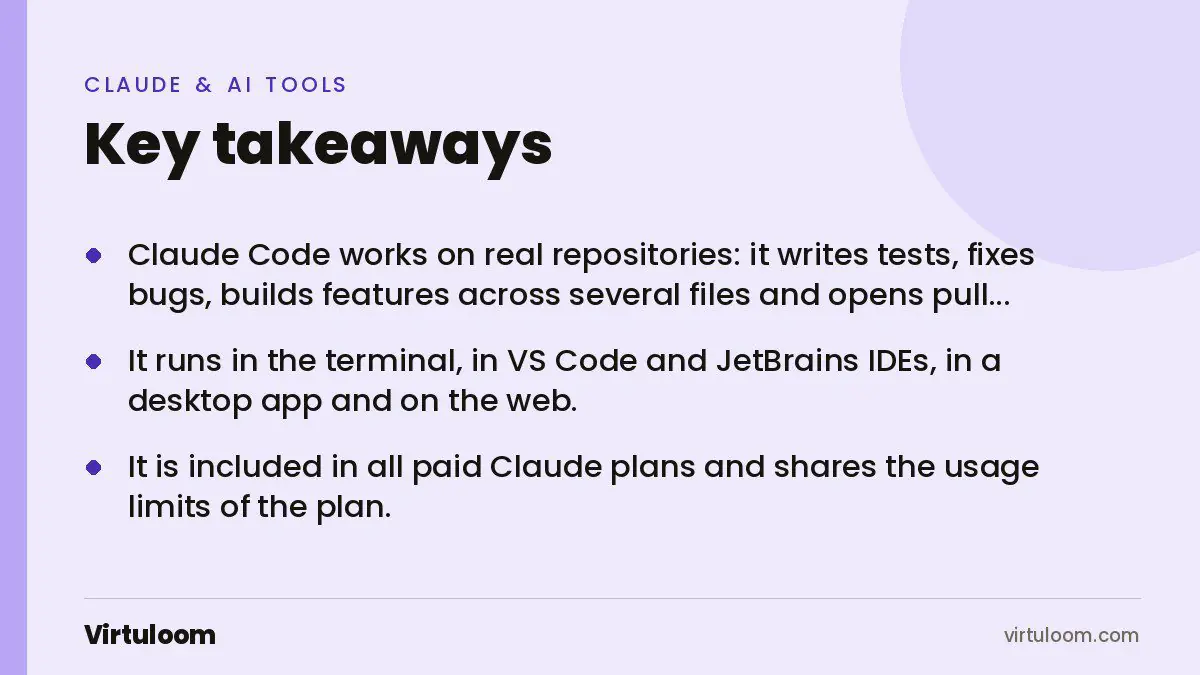
- Claude Code works on real repositories: it writes tests, fixes bugs, builds features across several files and opens pull requests.
- It runs in the terminal, in VS Code and JetBrains IDEs, in a desktop app and on the web.
- It is included in all paid Claude plans and shares the usage limits of the plan. As of October 2026, a Team plan Standard seat is US$20 per month on annual billing and a Premium seat is US$100.
- On Team and Enterprise plans, your content is not used for model training by default.
- It speeds up a developer. It does not replace code review, testing or someone who understands the system.
What is Claude Code?
It is an AI tool that does development work inside your project instead of only suggesting code in a chat window. You describe a task in plain language. Claude Code reads the relevant files, plans the change, edits the code, runs the commands needed to check it, and shows you what it did.
Anthropic offers it on several surfaces: a command-line tool, extensions for VS Code and JetBrains IDEs, a desktop app and a browser version for longer tasks that run in the cloud. They share the same engine, so project rules and tool connections carry across.
What can it do for a software team?
It takes over the work developers tend to postpone, and it speeds up the work they do every day. Anthropic’s documentation lists these uses:
- Housekeeping: writing tests for untested code, fixing lint errors, resolving merge conflicts, updating dependencies and writing release notes.
- Features and bugs: building a feature from a description, or tracing an error to its cause and fixing it.
- Git work: staging changes, writing commit messages, creating branches and opening pull requests.
- Connected tools: reading design documents, tickets and chat threads through the Model Context Protocol, an open standard for connecting AI tools to other systems.
- Team rules: following a project file that holds your coding standards and review checklist, and reusable skills for workflows such as reviewing a pull request.
- Scheduled work: running a task on a timetable, for example a weekly dependency check.
What does Claude Code cost?
Nothing on top of a paid Claude plan. Anthropic’s pricing page states that Claude Code is included in all paid plans and draws from the same usage pool as the rest of the plan. The figures below are from that page as of October 2026, in US dollars and excluding tax.
| Plan | Price | Fits |
|---|---|---|
| Pro | US$17 a month on the annual plan, US$20 billed monthly | One developer trying it on their own work |
| Team, Standard seat | US$20 per seat per month on annual billing, US$25 monthly | Most team members |
| Team, Premium seat | US$100 per seat per month on annual billing, US$125 monthly | Developers who code with it all day, with five times the usage |
| Enterprise | US$20 per seat per month, billed annually, plus usage at API rates | Larger companies that need audit logs, SCIM and role-based access |
For a five-developer team, a sensible start is five Standard seats, then a Premium seat for anyone who keeps reaching the limit. Seat types can be mixed on one plan.
Does it help a business that is not a software company?
Yes, through the people who build for you. A trading company, a clinic group or a real estate agency rarely needs Claude Code itself. It needs the internal tool, the website change or the report script delivered sooner and with fewer errors. If your developer or agency works with Claude Code and a proper review process, small changes that used to wait in a queue get done in the same week.
Ask your development partner two questions: do you use an AI coding agent, and how do you review what it writes? The second answer matters more than the first.
What are the risks, and how do you control them?
- Unreviewed code. Every change should arrive as a pull request that a person reads before it is merged. The agent proposes, a developer approves.
- Secrets. Keep passwords, API keys and customer data out of prompts and out of the repository.
- Wide permissions. Let it work in a branch, on a copy of the data, with only the access the task needs.
- No tests. An agent that can run tests checks its own work. Without tests, nobody knows whether a change broke something.
- Personal accounts. Put developers on a company plan. Team and Enterprise plans are not used for model training by default, and the company keeps control of the workspace.
How should a team start?
- Pick one repository and two developers for a two-week trial.
- Write the project rules file: coding standards, how to run the tests, what must never be changed.
- Start with low-risk work: tests, documentation, small bug fixes.
- Review every pull request as you would a junior developer’s.
- After two weeks, compare what was delivered, then decide how many seats you need.
How Virtuloom helps
Virtuloom uses Claude Code in its own custom software and web development work, with human review on every change. We also set it up for client teams in the UAE and Saudi Arabia: the plan and seats, the project rules, shared skills and the review process. When the goal is a task that runs by itself, we build an AI agent instead.
For a wider look at the assistants themselves, including team plans and data residency in the UAE, read Claude vs ChatGPT vs Gemini vs Copilot for Gulf businesses.
For the non-developer side of Claude, read how Claude Skills turn company playbooks into reusable workflows.
Frequently asked questions
Is Claude Code free?
It is not part of the Free plan. Anthropic’s pricing page lists Claude Code as included in all paid plans, starting with Pro, and it uses the same usage limits as the rest of your plan. Heavy users can also pay as they go through an API account.
Is Claude Code included in the Team plan?
Yes. Every Team plan seat includes Claude Code. A Standard seat is US$20 per month on annual billing and a Premium seat is US$100, with five times the usage, as of October 2026.
Do you need to be a developer to use Claude Code?
It is built for developers, because someone has to judge whether the change is correct and safe. Non-developers benefit when the developers or agency they work with use it under a clear review process.
Does Claude Code work in VS Code?
Yes. There are extensions for VS Code and for JetBrains IDEs such as IntelliJ IDEA and PyCharm, as well as a terminal tool, a desktop app and a web version.
Is our code used to train the model?
Not by default on business plans. Anthropic states that Team and Enterprise plans have no model training on your content by default. On individual plans, model training is an opt-out setting.
Sources
- Anthropic: Claude Code documentation, overview
- Anthropic: Claude plans and pricing (checked October 2026)
Want Claude Code set up for your developers, or software built with it? Talk to Virtuloom.